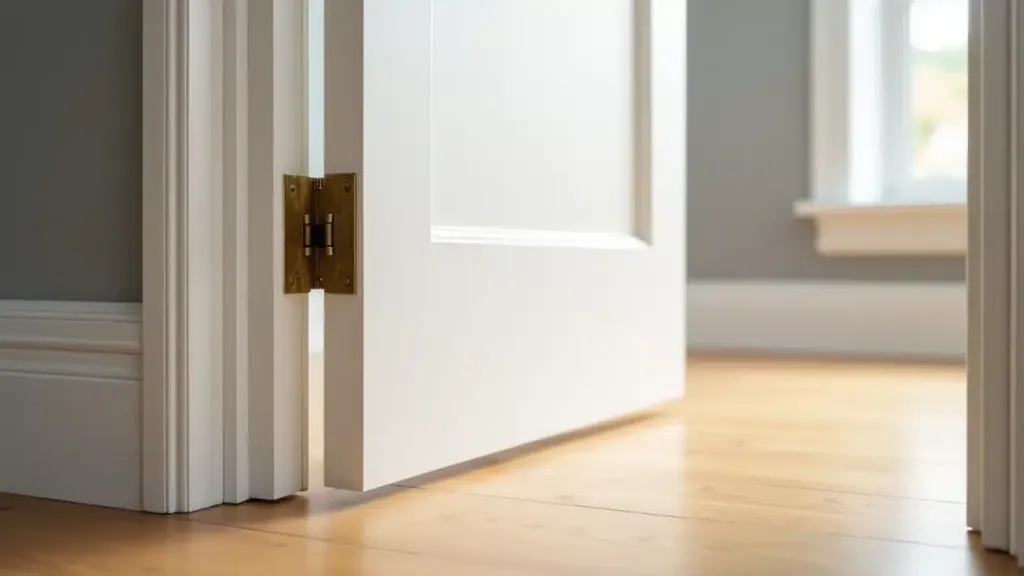
A door jamb is part of a door frame. The frame is the assembly around the door; the side jambs are the upright pieces on either side. One carries the hinges, and the other receives the latch.
You don’t have to choose which part “matters most.” You need to identify which part is causing trouble. A split latch-side jamb and loose decorative trim call for different repairs.
A plain-language guide to the parts
| Part | Where you’ll find it | What it does |
|---|---|---|
| Door slab | The moving door panel | Opens and closes within the frame |
| Hinge jamb | Upright frame member on the hinge side | Supports the hinges and door |
| Latch or strike jamb | Upright frame member opposite the hinges | Receives the latch and strike plate |
| Head jamb | Across the top of the frame | Completes the upper frame |
| Casing | Trim around the opening on the wall face | Covers the joint between the frame and wall |
| Sill or threshold | Bottom of an exterior door opening | Forms part of the bottom transition and weather-sealing system |
JELD-WEN describes the frame as including the head, jamb, and sill. Not every interior door has a threshold, and product terminology can vary. Pointing to the part in a photo is often the easiest way to avoid confusion.
The structural framing inside the wall is another part of the opening. Decorative casing should not be mistaken for the support behind it.
Match the symptom to a closer inspection
A door that rubs near the top may have a hinge or alignment problem. A latch that misses the strike could involve the latch, hinge position, or frame movement. Neither symptom proves that the whole frame needs replacement.
Look at the gaps around the closed door. Note where it rubs, whether the problem changes with the weather, and whether the latch works when you gently lift the handle. Don’t force a damaged door or dismantle security hardware just to test it.
For an exterior door, photograph any soft wood, peeling finish, or water marks near the bottom. Replacing a damaged piece without addressing water entry can leave the cause in place.
Can you replace just one jamb section?
Sometimes. It depends on how far the damage extends and whether a repair can provide sound fastening and proper door operation.
Our Fort Worth door-jamb repair cost $667.50. It involved part of the latch-side jamb, caulk and paint, and adjustment of the customer’s handle. That is a documented example of a partial repair, not a promise that every split jamb can be treated the same way.
A separate Fort Worth sticking-door repair cost $272 and addressed the hinge. These completed-job totals show why identifying the cause comes before choosing a replacement.
What to ask for in the quote
Have the repairer name the parts being kept and the parts being replaced. Ask whether trim removal, paint, hardware adjustments, and cleanup are included.
If decay or damage may continue behind the visible frame, agree on how additional work will be documented and approved. A door that needs to latch securely should be checked for operation when the repair is complete.
Send Smart Fix photos of the whole door and the damaged part. Add a sentence about where it sticks or how the latch behaves. That is enough to start a useful review without needing to learn every door-part name.
Need a Handyman You Can Trust?
Tell us what needs fixing. We’ll help you get a fair quote for the work.