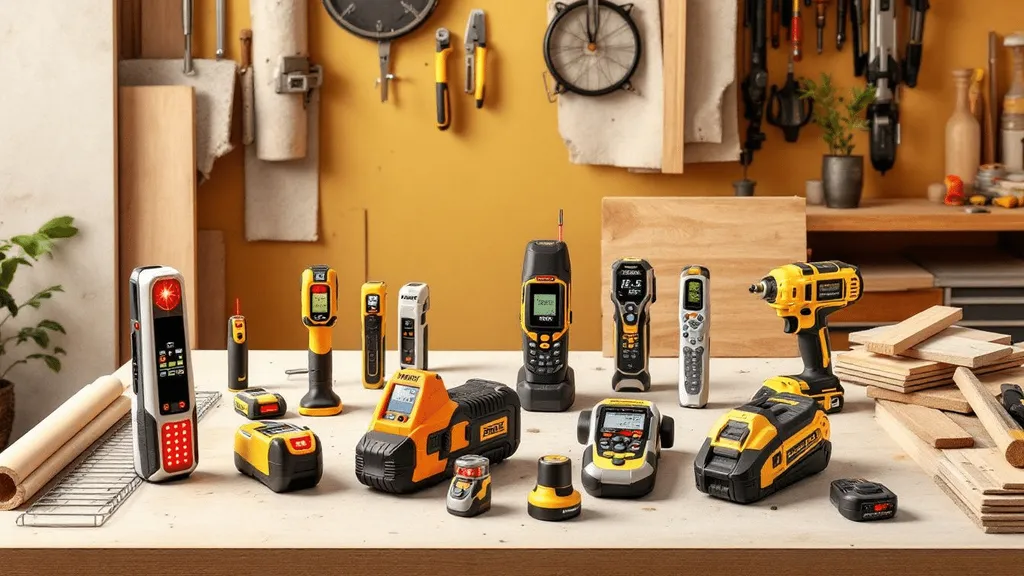
A stud finder gives you clues about what’s behind the wall. A magnetic model finds metal, often the screws or nails holding drywall to framing. An electronic model senses changes through the wall surface.
Neither gives you a complete picture of hidden pipes and wiring. A promising stud reading is one part of planning a safe fastening point.
Magnetic and electronic tools work differently
| Tool type | What the reading usually indicates | Main limitation |
|---|---|---|
| Magnetic finder | Ferrous metal such as a drywall screw or nail | The metal may belong to something other than a stud. |
| Electronic edge finder | A change that may mark a stud edge | Surface layers, calibration, and nearby materials can affect the reading. |
| Electronic center finder | A calculated or displayed stud position | Its accuracy still depends on the wall and the tool’s instructions. |
| Tool with live-wire warning | A detectable electrical field under specified conditions | No warning does not prove there is no wire. |
Zircon’s tool glossary describes electronic edge finding as sensing a change in density. Read your model’s manual to learn whether it needs calibration and where that should happen.
Check a reading before marking a hole
Start with a suitable battery and the mode required for your wall. Hold and move the tool as the manufacturer directs.
Scan across the suspected location more than once, including from the other direction. If you’re finding edges, mark both rather than treating the first alert as the center.
Repeat at another height to see whether the pattern makes sense. A single magnetic hit or broad electronic signal could be a fastener, corner reinforcement, or another object. Expected stud spacing can help you interpret a pattern, but it does not prove what’s at the drilling point.
Wall materials can confuse the tool
Lath and plaster, tile, foil-backed materials, multiple board layers, and damp surfaces may limit a particular model. A deeper scanning mode is not automatically more accurate.
For example, Zircon’s StudSensor L50 manual lists material and depth limitations. It also explains that its wire warning may miss live wires in conduit, behind certain materials, or beyond its detection depth.
Those details are a reason to use the correct tool for the surface, not to keep scanning until one pass gives the answer you want.
A wire warning is not an electrical safety test
Some detectors require an energized circuit to detect its electrical field. Follow the detection procedure in the manual, then use appropriate electrical isolation before work. Turning off a circuit first may prevent that type of warning from functioning.
More importantly, a stud finder cannot confirm that the planned drilling path is clear. Consider nearby fixtures, plumbing, and electrical devices. If the hidden services are uncertain, get qualified help rather than making a test hole.
Don’t drill through a metal plate you encounter behind the wall. It may protect a cable or pipe.
Heavy fixtures need a fastening plan
Finding a stud doesn’t tell you the correct screw length or how much weight a mounting system can hold. The bracket, fasteners, framing, and installation all have to suit the load.
Our Fort Worth upper-cabinet securement project involved securing a tall cabinet and repairing top trim. For work like that, locating support is only part of the job.
If you’re mounting a TV, cabinet, or heavy shelf, send us the product details and a photo of the wall. Include nearby outlets and fixtures so the installation can be assessed as a whole.
Need a Handyman You Can Trust?
Tell us what needs fixing. We’ll help you get a fair quote for the work.